
Two markets. One growing relationship.
Indian manufacturing depth, technology and capital meeting Rwandan market access, administrative reform and regional reach.
A small market with an outsized position.
Rwanda's value to an Indian business is rarely its own consumption. It is what a Kigali base makes possible across the region.
Gateway position
Access to the East African Community and a wider regional market from a single base.
Reform record
A consistent, well-documented record of business-environment reform and predictable administration.
Security & stability
One of the safest operating environments on the continent, with reliable institutions.
Digital government
Online registration, licensing and tax filing that materially shortens setup time.
Green ambition
A national agenda around clean energy, sustainable urbanism and climate-smart agriculture.
Talent pipeline
A young workforce and a growing technical and vocational training system.
Capability that travels well.
What Indian enterprise brings to the corridor is not only capital — it is products and processes already proven in comparable markets.
Manufacturing depth
Cost-competitive capacity across pharmaceuticals, machinery, textiles and building materials.
Technology & services
Global-scale IT services, engineering talent and digital public infrastructure experience.
Development finance
Established lines of credit and project finance instruments active across Africa.
Frugal innovation
Products engineered for price-sensitive markets — directly transferable to Rwanda.
Diaspora networks
A long-established Indian business community across East Africa.
Institutional links
Deep bilateral ties across trade bodies, universities and government agencies.
Delhi, Mumbai, Ahmedabad → Kigali.
Bilateral trade has grown steadily, but volume alone is a poor guide to opportunity. Composition matters more: pharmaceuticals, machinery and vehicles dominate the Indian export basket, while Rwandan exports stay concentrated in a small number of primary commodities.
The interesting question is where value addition moves next — processing that happens elsewhere today and could credibly happen in Rwanda, given power costs, skills and regional market access.
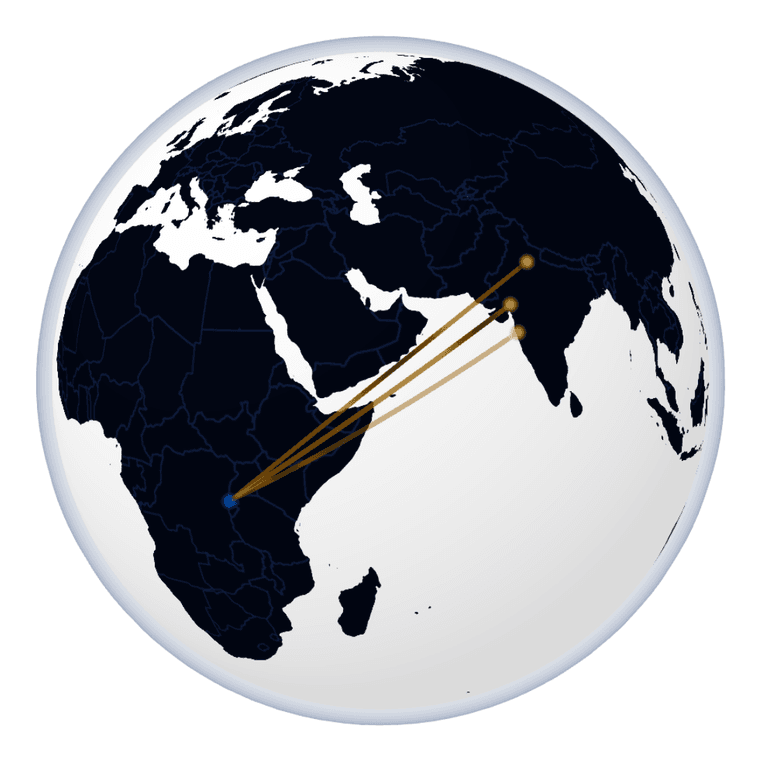 Interactive globe showing trade corridors between Indian cities and Kigali, Rwanda. Drag to rotate.
Drag to rotate
Where opportunity meets ambition.
Eight sectors where Rwandan demand and Indian capability line up most cleanly today.

01
Agriculture
Value addition, cold chain, irrigation technology and export-grade processing.

02
Manufacturing
Light manufacturing, pharmaceuticals, packaging and building materials.

03
Infrastructure
Roads, housing, industrial parks, water and urban development projects.

04
Healthcare
Hospitals, diagnostics, medical devices and pharmaceutical distribution.

05
Technology & Innovation
Fintech, digital public infrastructure, IT services and engineering talent.

06
Tourism & Hospitality
Hotels, MICE facilities, eco-tourism and destination services.

07
Energy
Solar, mini-grids, energy storage and productive-use appliances.

08
Logistics
Freight, warehousing, cold storage and regional distribution hubs.